Annual Direct Normal Irradiation (DNI) should be greater than 1900 kWh/m2 (Zhao et al.2009).
Flat land area with an overall slope of less than 1–3% (Yang et al.2010), as the intensity of solar radiation is essentially controlled by the ground slope at a certain location (Allen et al.2006). Due to various parameters such as self-shadowing and shading cast by surrounding terrain, the amount of radiation intercepted by the collectors is significantly reduced. As a result, land with a steeper slope has an impact on solar plant productivity.
The wind speed should be less than 15.64 m/s in order to decrease the stresses applied to the support structure of the solar collector assembly (Shahrukh Saleem and ul Asar2021).
Availability of accessible grid connections if the CSP project is not designed to fulfill a specific local (site) demand for industrial applications.
Availability of water resources, as the large amount of water consumed in the cooling towers is one of the disadvantages of CSP for power generation.
The availability of good transportation facilities is a socio-economic aspect that should be considered in developing remote areas where CSP projects are usually built.
Consideration of protected areas, wildlife traffic, and agriculture.
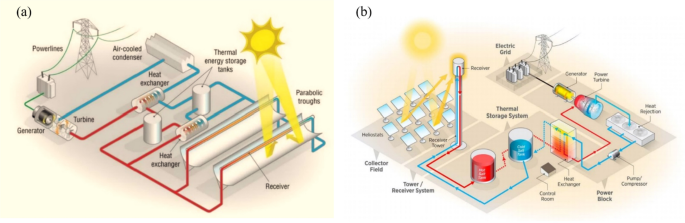
The solar tower configuration requires 25% more land than the parabolic trough configuration. This increase in collector area elevated the solar tower’s net capital cost by 15% above the parabolic trough.
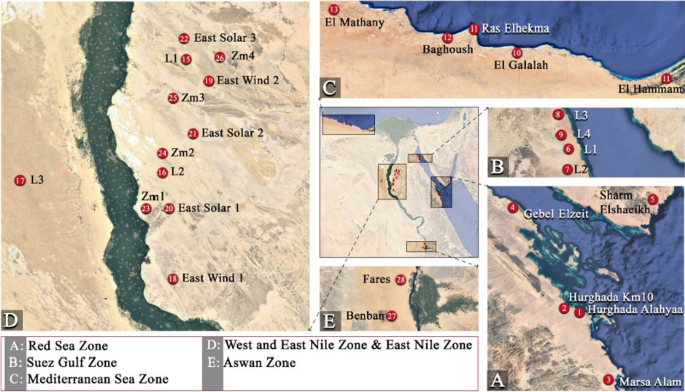
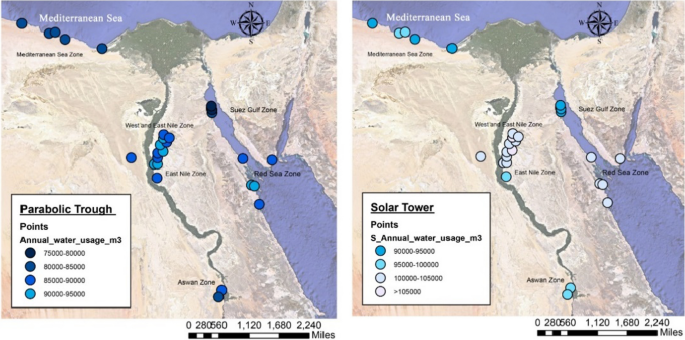
For both technologies, plants in the northern zones (Mediterranean and Suez Gulf) consume less water than those in the central, eastern, and southern zones.
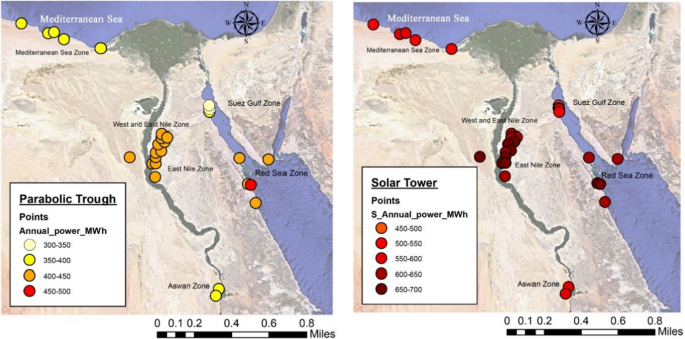
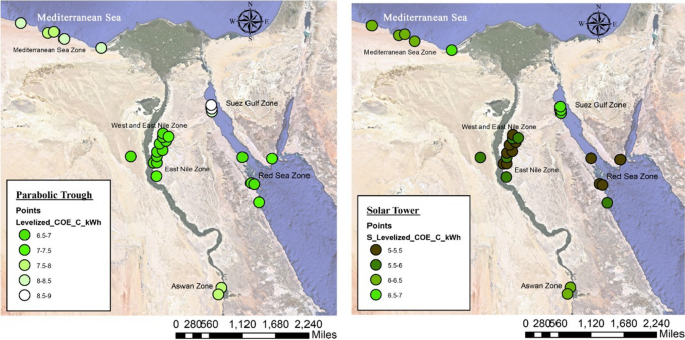
Plants implemented in the central zone (Nile zones) generate more annual electricity output than plants in the southern region (Aswan), eastern zone (Red Sea), and northern zone (Mediterranean Sea and Suez Gulf), respectively.
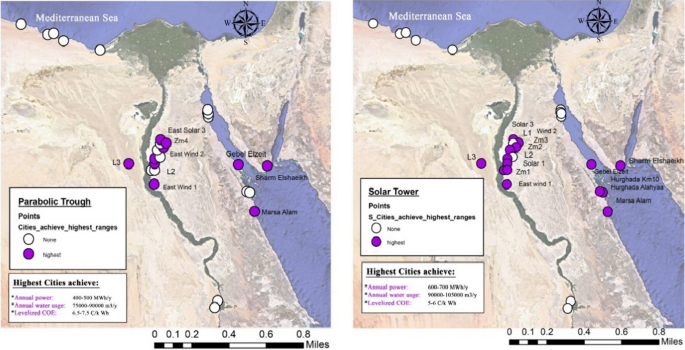
According to the parametric analysis, the eastern zones have been shown to be an advantageous area for implementing both indicated technologies.